Localize Your Website into Arabic
Reach over 420 million Arabic speakers across 22 countries and a large global diaspora. Arabic localization requires right-to-left layout, the right written register for your audience, and dialect choices that shift by country. MotaWord matches native linguists by dialect and region, with full RTL support from translation through to your live site.


Arabic at a Glance
- Native Speakers.
- Most used language online.
- Official status.

One of the fastest-growing digital markets in the world
The Arabic-speaking world spans some of the highest mobile internet adoption rates globally, with e-commerce growing faster than in most Western markets.
$3.5 Trillion GDP
$3.5 Trillion in combined GDP across the Arab League's 22 countries.
$50 Billion Market
$50 Billion projected MENA e-commerce market size by the end of 2026.
4th Largest Language
4th most-used language online, measured by total web content volume.
1.8 Billion Muslims
1.8 Billion Muslims worldwide for whom Arabic holds religious significance.
Arabic-speaking markets, by reach
Arabic is official across 22 Arab League countries. Below are the largest by native speakers, but “Arabic” is not one written or spoken standard, so market choice should follow your actual customer base, not just population.
UAE Official ~1M native, high commerce volume
Small native population but a regional commerce and logistics hub
- Egypt: Official, ~109M native. Largest Arabic-speaking population, Egyptian Arabic widely understood via media
- Algeria: Official, ~40M native. Maghrebi Arabic, heavy French influence in business contexts
- Iraq: Official, ~32M native. Mesopotamian Arabic, distinct from both Gulf and Levantine varieties
- Yemen: Official, ~29M native. Distinct dialect group, limited e-commerce infrastructure currently
- Morocco: Official, ~29M native. Maghrebi Arabic (Darija), significant French and Amazigh influence
- Saudi Arabia: Official, ~27M native. Gulf Arabic, highest e-commerce spend per capita in the region
- Syria: Official, ~19M native. Levantine Arabic, shared mutual intelligibility with Lebanon and Jordan
Cultural and linguistic considerations
Arabic localization mistakes tend to come from treating it as one market with one layout, when it's really 22 markets sharing a script.
- Right-to-left is a layout change, not a text change {.h4}: Navigation, icons, forms, carousels, and progress indicators all need to mirror, not just the body text. A page that's RTL text in an LTR layout looks broken, not localized.
- MSA vs. dialect is a strategic choice, not a default: MSA is safe and universal but can feel formal for consumer marketing. Dialect content converts better with a specific market but won't travel well to others.
- Gulf, Levant, and North Africa are different audiences: Purchasing power, tone expectations, and even vocabulary differ enough that a single "Arabic" campaign across all three often underperforms a market-specific one.
- Imagery and product context: Alcohol, gambling, and non-halal food imagery need market-specific review. Timing product launches around Ramadan and major holidays also affects campaign performance.
- Numeral systems vary by country: Western Arabic numerals (0-9) are standard in the Gulf and Levant, while Eastern Arabic-Indic numerals still appear in parts of North Africa and Egypt. Confirm this for each target market.
- Weekend and business-day differences: Most Gulf countries run a Friday-Saturday or Sunday-Thursday work week. Delivery estimates, support hours, and promotional timing need to reflect this, not a Western Monday-Friday assumption.
What Arabic localization does for search and reach
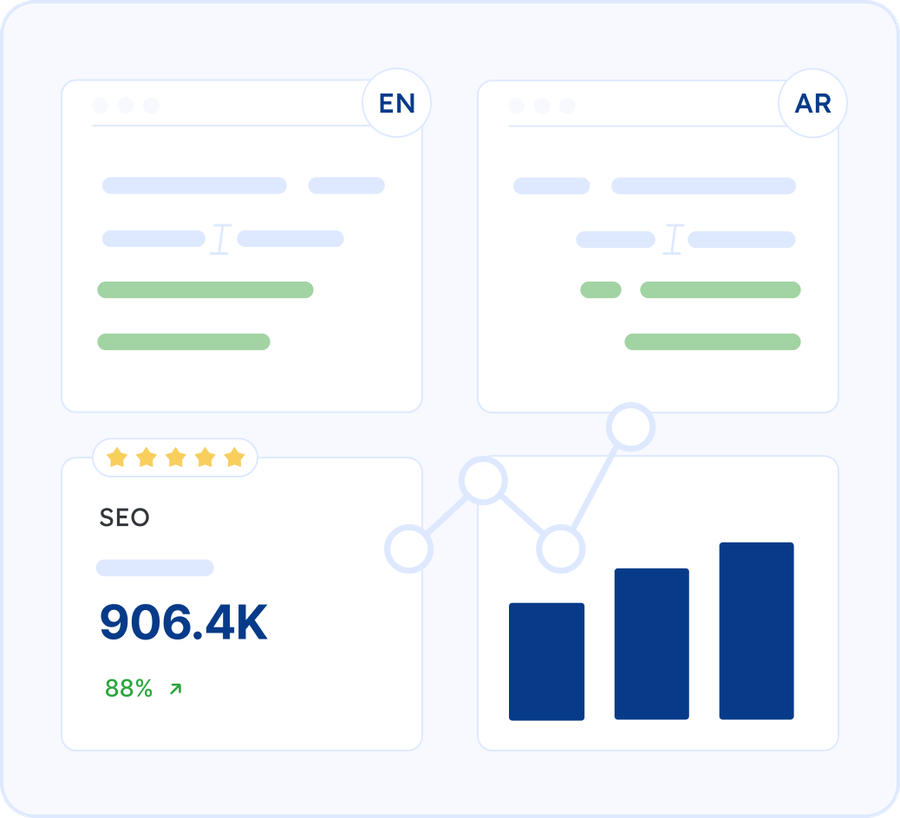
Arabic search behavior is shaped by both dialect variation and near-universal mobile-first browsing, and RTL rendering has to work correctly for any of it to matter.

RTL rendering as a ranking factor
Google's mobile-first indexing penalizes broken or partial RTL layouts. A mirrored, functional layout is a technical SEO requirement here, not just a design nicety.

Hreflang by dialect region
Ar-SA, ar-EG, ar-AE and others can rank differently for identical MSA content. Hreflang tagging by country lets you serve and rank the right version per market.

Dialect-aware keyword research
People often search in colloquial spellings, not just MSA. Keyword strategy needs region-specific research, not a single Arabic keyword list applied everywhere.

Mobile-first by default
MENA has some of the highest mobile internet usage rates globally. Page speed and mobile UX carry outsized weight for Arabic-market rankings.
What sets our Arabic localization apart

Native linguists by dialect and region
Translators matched to Gulf, Egyptian, Levantine, or Maghrebi Arabic specifically, not a single generic pool.
Full RTL support
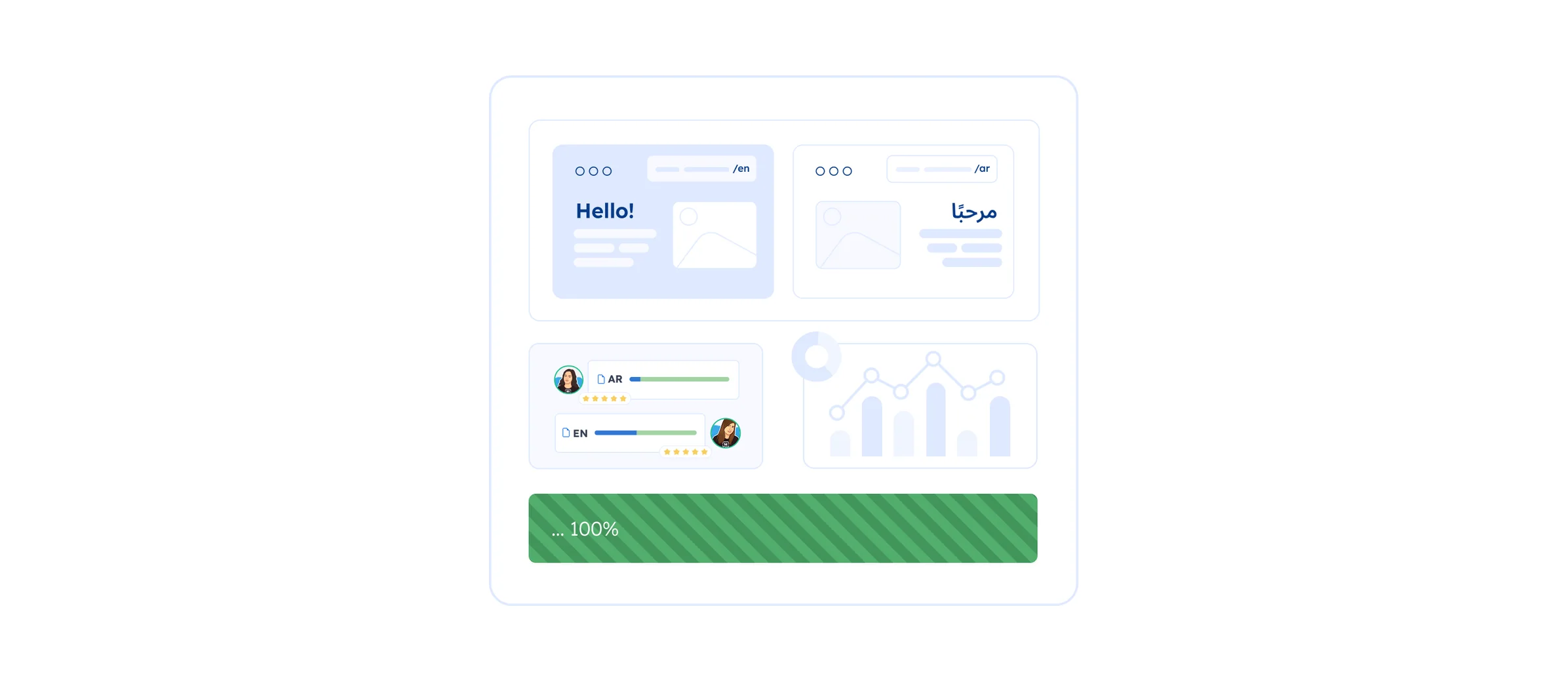
Our DTP and web integration team handles full layout mirroring, not just text direction, across WordPress, Drupal, and custom sites.

MotaWord Active
AI makes your website multilingual instantly. Discounted professional translation is available as an optional add-on when you want human review on the pages that matter most.

Fast Professional Proofreading Turnaround
Our collaborative translation model gets full-site projects done in hours, not the weeks a traditional agency needs.

MSA and dialect options
We help you decide, market by market, whether MSA or a regional dialect will perform better for your content.

24/7 live support
Direct access to your project team throughout, with no ticket queue.
Need Arabic beyond your website?
MotaWord supports Arabic beyond website localization, from official document translation to live interpretation.
- Certified Arabic translation: Live on site. USCIS-accepted certified translation for birth certificates, diplomas, transcripts, and other official Arabic documents. View certified translation →
- On-site Arabic interpretation: In-person interpreters for legal proceedings, medical appointments, school meetings, and business events. on-site interpretation services
- Video and phone Arabic interpretation: On-demand VRI and OPI interpreters for remote Arabic-language support, available 24/7. on-site vs VRI vs OPI interpretation
Translating and localizing a website into Arabic
Not sure where to start?
Tell us about your site in the chat. Answer one quick question and we'll point you to the right next step.
The cost of translating a website with MotaWord depends on the workflow you choose. For file-based website localization, you send us the text, pages, or strings you want translated, and pricing is based mainly on word count and project scope. If you want a more complete website workflow, MotaWord Active runs on a subscription matched to your site. Active makes your website multilingual instantly with AI, includes multilingual SEO support, ongoing content updates, a no-code workflow, and 24/7 live support. If you want human review, discounted professional translation is available as an optional add-on.
MSA is the safer default for broad reach, legal, and formal content. If you're focused on one market, such as Saudi Arabia or Egypt, a dialect-adapted version of your marketing copy typically converts better.
A full RTL localization mirrors the entire layout, including navigation, icons, and forms, not just the text direction. Partial RTL implementations are one of the most common and most visible localization mistakes.
It depends on your product and existing traffic, but Saudi Arabia and the UAE lead in e-commerce spend, while Egypt offers the largest addressable population. We can help map this against your current site analytics.
With MotaWord Active, your website can be localized into Arabic in minutes. Full-site professional translation projects are done in hours, not the weeks a traditional agency needs.
Yes. MotaWord Active makes your website multilingual instantly, and discounted professional translation is available as an optional add-on when you want human review on the pages that matter most.
No. MotaWord Active translates your site without any coding, and we also offer plugins and integrations for platforms such as WordPress and Drupal. See how MotaWord Active works.